
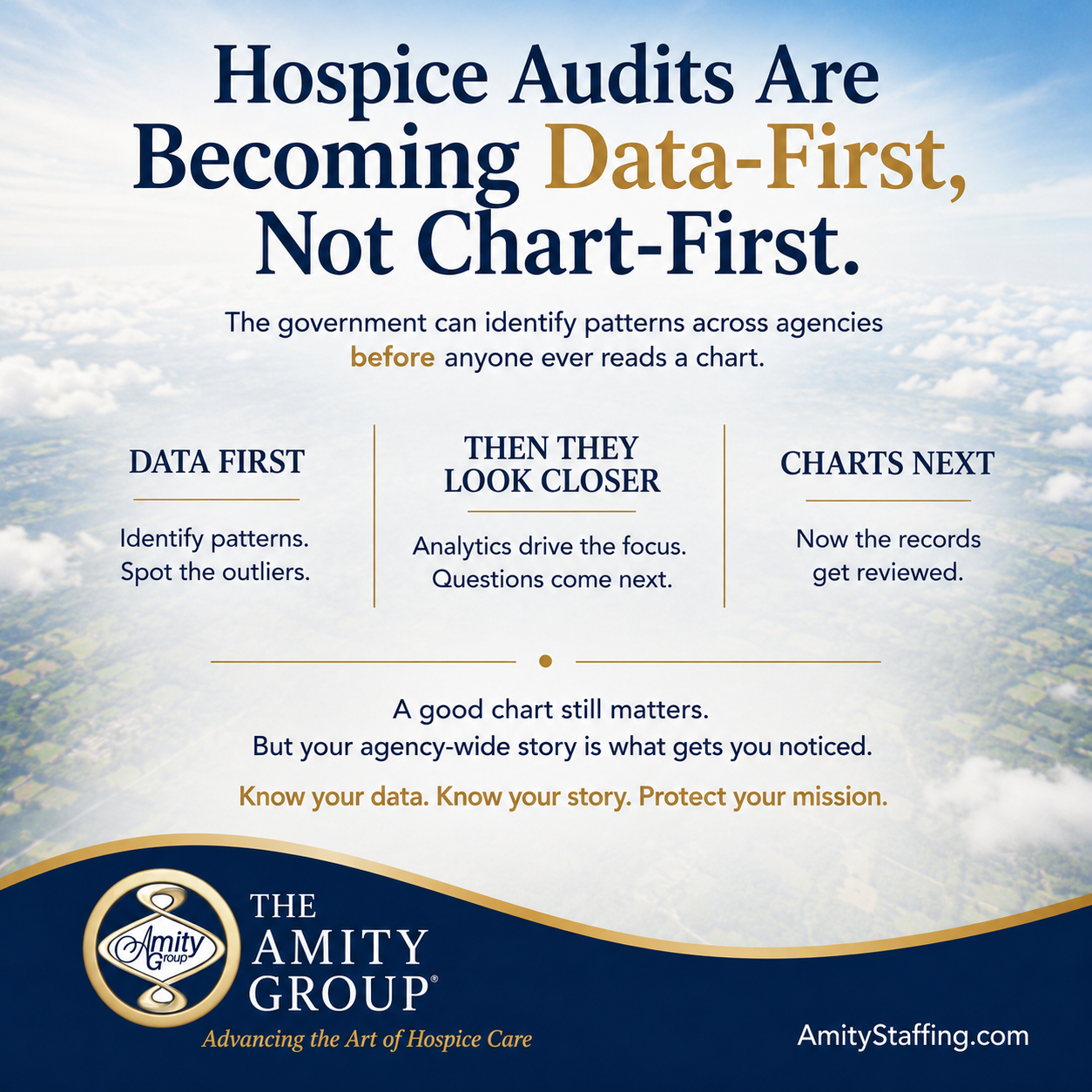
That work is still incredibly important, and nothing about that has changed. But I think hospice leaders need to start looking at compliance from a different direction because the federal government increasingly has the ability to decide it wants to look at your hospice before anyone ever reads the first chart.
DOJ Just Created a National Fraud Detection Center
On August 24, 2026, the U.S. Department of Justice announced the launch of its new National Fraud Detection Center, or NFDC. This is not a new hospice regulation. It does not create a new Condition of Participation, documentation requirement, or reporting requirement for hospices. But I would not dismiss this as general fraud news that has nothing to do with us.
The NFDC is a prosecutor-led, multi-agency operation designed to combine federal investigative resources, technology, and analytics to identify fraud across taxpayer-funded programs. DOJ specifically says the center is intended to break down the silos that have historically prevented agencies from seeing patterns across different government programs. Participants include the FBI, HHS Office of Inspector General, IRS Criminal Investigation, FinCEN, Homeland Security Investigations, other federal Inspectors General, and state partners.
DOJ’s National Fraud Enforcement Division is also very clear about the direction it is taking. Its stated approach includes advanced data-driven investigative techniques and coordination with agencies that administer federally funded programs. What that tells me is that the traditional picture of an investigation is changing. We tend to think someone finds a questionable claim, looks at the record, finds a problem, and then starts digging. Increasingly, the government has the ability to identify an unusual pattern first and then investigate why that pattern exists.
Why This Matters to Hospice
Hospice is already sitting under a very bright federal spotlight. On May 13, CMS implemented a six-month nationwide moratorium on new Medicare hospice and home health enrollment, including certain changes in majority ownership. CMS specifically described hospice and home health as high-risk provider categories and characterized the action as part of its broader, data-driven effort to combat fraud, waste, and abuse.
That alone should tell us something about the environment we’re operating in. The government isn’t limited to asking whether Mrs. Smith met hospice eligibility criteria on the day she was admitted. It increasingly has the ability to look at an entire hospice from 30,000 feet and identify patterns that stand out.
Hospice leaders should know what their own data says about things like:
- Average and median length of stay
- Live-discharge rates and reasons
- Discharges followed by readmission
- Visit utilization and visit intensity
- Non-hospice Medicare spending
- Admission patterns
- Diagnosis patterns
- Referral concentrations
- Changes in utilization over time
- Other areas where the agency differs significantly from its peers
None of those things by themselves prove that an agency is doing anything wrong. Being an outlier is not the same thing as committing fraud. There can be completely legitimate clinical, geographic, demographic, and operational reasons why one hospice looks different from another. But an unusual pattern can be what causes someone to start asking questions, and that distinction matters.
A Good Chart Isn’t the Whole Compliance Picture Anymore
I spend a tremendous amount of time talking about documentation because documentation remains one of our biggest vulnerabilities in hospice. If Medicare requests a patient’s record, that record has to stand on its own and demonstrate why the patient was eligible for hospice and why the services provided were reasonable and necessary.
But leaders cannot stop there anymore. You could pull one chart and find beautiful documentation. The physician narrative is individualized, the nursing notes support the terminal diagnosis, the decline is clear, the plan of care makes sense, and everything is defensible. That still doesn’t tell you what your organization-level data looks like.
If something unusual is happening across hundreds or thousands of claims, the government doesn’t necessarily have to stumble across the right chart first. Analytics can identify the pattern, and then someone can come looking for the records.
That’s a very different compliance environment from the one many hospices are accustomed to.
Start Looking at Your Hospice the Way the Government Can
If I were running a hospice today, I would want my compliance and QAPI programs looking beyond individual chart audits. I would absolutely continue auditing eligibility and documentation, but I would also routinely step back and look at the organization as a whole.
What are our trends? Where are our outliers? What changed this quarter compared with last quarter? What changed this year compared with last year? Where are we significantly different from our peers? And when we find something unusual, can we explain why?
Sometimes the explanation may be completely reasonable. Maybe your length of stay changed because your referral mix changed. Maybe utilization increased because you’re caring for a higher-acuity population. Maybe live discharges changed because something happened within your market or referral patterns. That’s fine, but you should know that before somebody outside your organization asks you to explain it. The goal isn’t to manipulate your numbers so you don’t look like an outlier. The goal is to understand your own organization well enough that you are never surprised by your own data.
Your Data and Your Medical Records Need to Tell the Same Story
This may be the biggest takeaway for me. Your agency-level data tells one story about your hospice, and your medical records tell another. Those two stories need to make sense together.
If your data shows unusually high utilization, your records should demonstrate the clinical needs driving that utilization. If your patients have unusually long lengths of stay, your documentation still needs to demonstrate continued eligibility throughout those stays. If you have unusual live-discharge patterns, leadership should understand what is driving them. When something looks unusual from 30,000 feet, you should be able to come down into the medical record and understand why. That’s where I think hospice auditing is headed. It isn’t moving away from the chart. The difference is that the data may increasingly come before the chart.
The Government Can Find the Outlier First
DOJ’s announcement matters because the National Fraud Detection Center is specifically designed to combine analytical capabilities and information across government programs and agencies. DOJ describes the initiative as addressing the lack of cross-program visibility that historically made some fraud more difficult to detect.
For hospice leaders, my message isn’t to panic. It’s to pay attention. CMS is already telling us that hospice is a high-risk area. Federal enforcement is becoming increasingly data-driven, agencies have more information available to them, and the government’s ability to identify unusual patterns continues to improve.
So don’t wait until an ADR, TPE, SMRC, or other review arrives before you start asking what your organization looks like. By the time someone asks for the chart, your agency’s data may have already given them a reason to look.
This Is Why Independent Review Matters
At The Amity Group, our hospice audit nurses spend every day reviewing records, identifying eligibility and documentation vulnerabilities, and working with agencies facing Medicare scrutiny. But I think the next generation of hospice compliance has to go further than simply asking whether an individual note is good enough.
Hospice leaders need to understand what their medical records say and what their organization looks like as a whole. When something doesn’t line up, you want to identify it internally, understand it, and address it before an outside reviewer starts asking the questions.
That’s where independent third-party review can be incredibly valuable. We aren’t looking at your records through the eyes of the nurse who wrote them or the leadership team that sees them every day. We’re looking for the contradictions, vulnerabilities, and questions that someone outside your organization may see. Because by the time the government asks for the chart, the data may have already told them where to look.
To learn more about The Amity Group’s hospice audit and compliance support division, visit AmityStaffing.com.
