
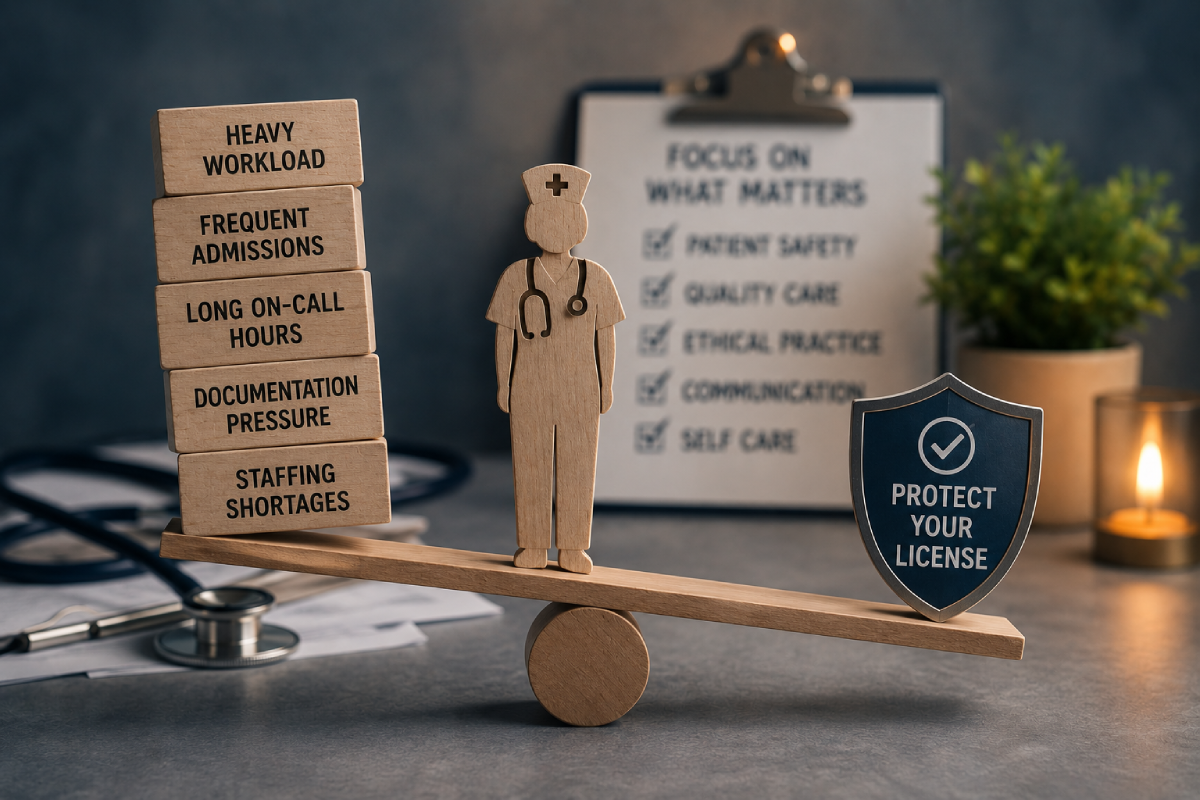
Protecting Your Nursing License: Recognizing Risk Before It Becomes a Problem
Hospice nursing is built on compassion, advocacy, and a commitment to doing what is right for patients and families. Every day, hospice nurses navigate complex clinical situations, emotional conversations, and demanding workloads while striving to provide exceptional end-of-life care.
Most nurses enter the profession because they want to help people. They are not thinking about audits, investigations, or disciplinary action against their license. In fact, most hospice nurses spend their careers making thoughtful decisions, acting in their patients’ best interests, and practicing safely.
However, there are situations where even good nurses can find themselves under immense pressure. When workloads become excessive, staffing becomes stretched, and expectations continue to grow, nurses may be placed in positions where they feel forced to choose between keeping up and doing things the right way.
That is where risk begins.
When Workload Starts Affecting Patient Care
Hospice nurses are accustomed to working hard. Long days, admissions that run late into the evening, and unexpected patient needs are part of the profession.
The challenge comes when those demands reach a level that is no longer manageable.
An excessive patient load, too many admissions, or repeated nights of on-call coverage can create physical and mental exhaustion. When nurses are overwhelmed, it becomes more difficult to complete documentation accurately, perform thorough assessments, and maintain the level of attention that patients deserve.
Most importantly, it can place nurses in situations where mistakes become more likely.
The reality is that many leaders may not realize when a nurse has reached that point.
Managers and supervisors often carry significant responsibilities themselves. They may be overseeing multiple teams, managing staffing challenges, handling regulatory requirements, and responding to operational issues throughout the day.
If a nurse continues accepting additional assignments without speaking up, leadership may assume the workload is manageable.
That is why communication is critical.
Speaking Up Is a Professional Responsibility
Many nurses hesitate to tell a supervisor they are overwhelmed.
Some worry about appearing incapable. Others do not want to let their team down. Many simply keep pushing forward because that is what healthcare professionals are known for doing.
But there is a difference between being dedicated and placing yourself in an unsafe situation.
When a workload reaches a point where patient care, documentation quality, or professional judgment could be affected, it is important to communicate that concern.
Having a conversation with leadership is not a sign of weakness. It is part of professional accountability.
Hospice nurses have an obligation to advocate not only for their patients but also for their ability to provide safe and effective care.
The Line That Should Never Be Crossed
While heavy workloads create stress, there are certain actions that carry much greater consequences.
Every hospice nurse should understand that no amount of pressure, staffing shortages, or operational challenges justifies falsifying documentation.
This includes:
- Signing documentation for visits that did not occur
- Claiming to have completed assessments that were not performed
- Documenting services that were not provided
- Signing forms for situations where you were not present
- Recording information that you know is inaccurate
These actions are not documentation shortcuts.
They are considered fraud.
In healthcare, documentation serves as the official record of care provided to patients. Medicare, regulatory agencies, and accrediting organizations rely on that documentation to verify services and support reimbursement.
When documentation intentionally misrepresents what occurred, the consequences can be severe.
Understanding the Real Consequences
Many nurses focus primarily on protecting their license, but the risks extend far beyond disciplinary action.
In cases involving fraudulent documentation, consequences may include:
- Loss of nursing licensure
- Exclusion from working in Medicare-funded healthcare settings
- Financial penalties
- Investigations by regulatory agencies
- Criminal charges in serious cases
These outcomes can permanently impact a nurse’s career and future opportunities.
No job, workload, or staffing situation is worth taking that risk.
Choosing the Right Path
If you ever find yourself in a situation where you feel unable to safely complete your responsibilities, the answer is not to cut corners.
The answer is to speak up.
Communicate your concerns. Ask for support. Discuss workload limitations. Request additional resources when necessary.
And if an organization consistently expects you to compromise your professional standards, it may be time to evaluate whether that environment is the right fit.
The healthcare industry needs skilled hospice nurses. There are organizations that value ethical practice, safe workloads, and clinical integrity.
You should never feel pressured to choose between your job and your professional obligations.
Building a Stronger Hospice Community
One of the greatest strengths within hospice is the willingness of nurses to support one another.
By sharing experiences, discussing challenges openly, and encouraging ethical decision-making, nurses help strengthen the profession as a whole.
Protecting your license is not about fear. It is about maintaining the integrity of the care you provide and ensuring that patients continue receiving the quality hospice services they deserve.
Every chart, every visit, and every patient interaction matters.
And when faced with difficult situations, choosing integrity will always be the right decision.
